Τετάρτη 18 Σεπτεμβρίου 2019

The Yemen epidemic: when geography and war lead to famine


Yemen, from time to time, gains a place in international news. The war raging for years in the Asian country has caused an international outcry. However, another fact that is not mentioned is that since the fall of 2016, the Yemeni people have been suffering from an outbreak of infectious diseases and especially cholera. This situation sounds the alarm in the scientific community, and it tends to turn into a humanitarian crisis. This article examines how geography and war together have a share of responsibility for this situation.


The "curse" of geography: a country not favored
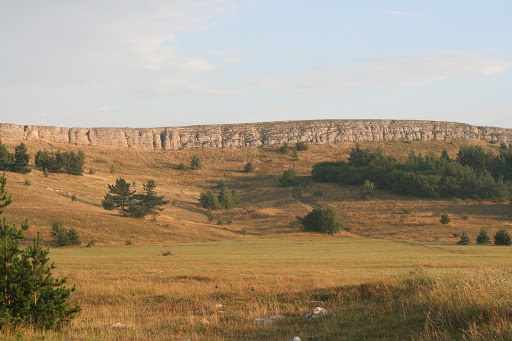
Yemeni landscape. Those highlands offer an opportunity for the development of agriculture, but are not many and cannot help boosting the production. As you can see, except the green fields, the other territory is infertile. (Credits: Commons. Wikimedia)


Yemen is located in the southern part of the Arabian Peninsula. It borders east to Oman, north to Saudi Arabia, west by sea to Djibouti and Eritrea. It is flowed by the Indian Ocean to the east and south and by the Red Sea to the west.

To the west, to the south and to the southeast, that is, to the seaside, lies the heart of the country's economic life. These areas are home to the largest urban centers, with large ports that allow trade, while fishing is also highly developed. Agriculture is also developed as fertile ground is found in those areas.

But the country is a little favored by geography. Most of the interior is deserted. In particular, this Arab state has mainly a mountainous terrain with many mountains as one goes inland, extending from west to east and occupying a large area. In the north, an area of ​​land is formed, called the 'Empty Square'. It is one of the largest desert areas in the world, a continuation of the vast desert of Saudi Arabia, named Rub al-Khali. It is characteristic that Yemen has no rivers and only when it rains there are streams that become dry when the weather warms. In this rough soil, there are some areas that offer opportunities for cultivation, but not enough production. Still, there are issues of water supply and drinking water, which aggravate the position of the Yemenis.

The fate of the country will be analogous to geography. The Arab country is a hot country, plagued by frequent sandstorms and the process of desertification. The climatic phenomena do not allow the development of agriculture and reduce it, as the fertile soil is constantly decreasing. Consequently, food crises are fatal, while mitigating the negative geographic-climate impact are the major ports in the Indian Ocean favoring imports of food and essentials. Nevertheless, Yemen is known for its problems in the field of nutrition and health.

The Arabian Desert. The same desert continues inside the Yemeni territory, making the soil rough and infertile. (Credits: FREE-PHOTOS- Pixabay)


The factor of  the war

The year 2011 is an important year for the Arab world. Then, a series of uprisings broke out in many Arab countries against the long-standing authoritarian regimes that led to their downfall in some of them and caused to others a civil war with regional and international implications. Yemen was supposed to belong to the latter category.

In January of this year, protests erupted against President Ali Abdullah Saleh with demands similar to other demonstrations. The government exercised violence and repression, and local conflicts erupted. At the same time, armed Islamists seized parts of the region to act as bases for their action. The country was on the brink of anarchy and collapse.

The peculiar civil war raging in Sana'a resulted in the assassination attempt on Saleh. It failed, but the Yemeni president fled to Riyadh injured and left Vice President Al-Hadi in his place. Meanwhile, the opposition formed its own political coalition, leading to a total government-opposition rupture. Finally, the government withstood the pressure and in the winter of 2012, a truce was signed. In the short term, peace returned to the country.

In autumn 2014, political developments in Yemen would take another turn. The Houthis, with their homonymous religious movement, from their bases in the northeast, a not so fertile part of the state, began to spread. They backed the outgoing President Saleh, opposed President Al-Hadi, who was in the meantime backed by the Saudi leadership and received support from Iran, who found the opportunity to undermine its rival, Saudi Arabia, in its “soft underbelly”.

The momentum of the Houthis worried the government and its foreign allies. The descent of them led to a new cycle of civil strife, which this time would prove disastrous for the country and its people. The first success of the Houthis was the capture of the capital. In other areas, the Houthis occupied government bases and parts of the territory. In January 2015, the Hadi government resigned and the split was complete.

In March 2015, a new civil war broke out between the Houthis and the faithful forces in the old government. The focus was on Aden's vital port, where the Houthis were defeated. In return, they occupied the third largest city in the Arab state, Tait, after a general attack. In the West, but also in the kingdoms of the Arabian Peninsula, the strengthening of the Houthis and, by extension, Iran, caused fear. The forces faithful to Hadi had to endure. External involvement would not be late.

The intervention of third countries was expressed by the creation of an Arabian coalition led by Saudi Arabia. Immediately, an air bombardment campaign swept Yemen with Houthis bases, water tanks, crop farms, food depots, civilian homes and other government buildings to become targets. At the same time, Al-Qaeda managed to conquer parts of the country after a victorious march. In the fall, the Houthis abandoned their efforts to capture Aden. Now, life for the Yemeni people would become unbearable.

In late 2015, and while the civil war raged along with outside intervention, Riyadh imposed a naval blockade on Yemen. This move was made in the context of a total war, since the Houthis, despite their efforts, could not be exterminated. Food, first aid and other goods could not be imported into the country either by land, by air or by sea. In the fall of 2016, the United States decided to join the embargo in an effort to pressure the Houthis to leave power, while eliminating Iranian influence.

External intervention was not the only cause of famine. Unable to obtain the goods necessary to continue their struggle, the Houthis launched a campaign of the seizure of those by ordinary citizens. Drugs, food, precious objects and drinking water became a target for Houthis’s men. It was an unpleasant situation that was supposed to prove disastrous for the society.
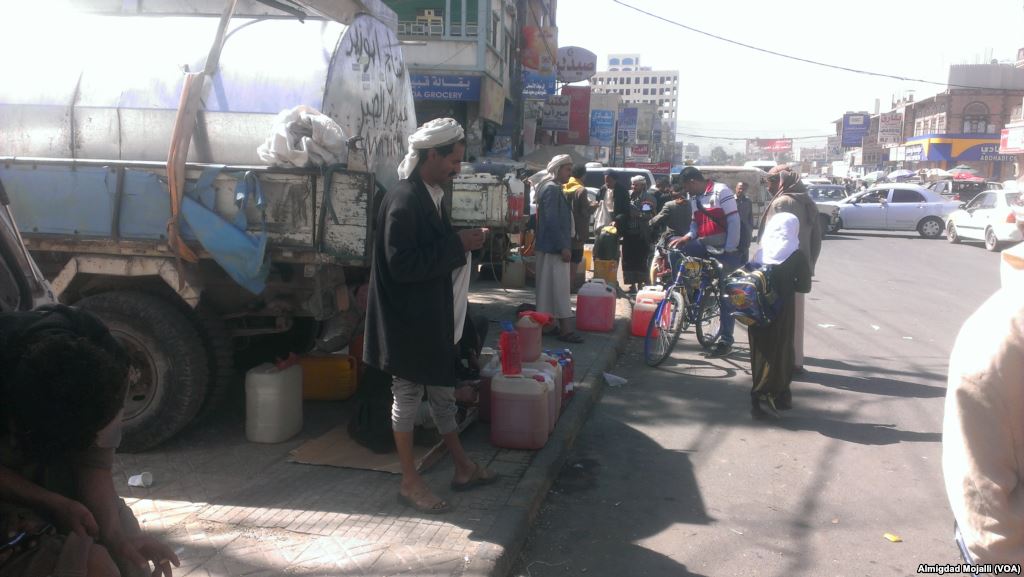


Yemenis waiting to buy fuel in the black market. Due to the naval block, the black market thrives in Yemeni cities, causing a lot of problems to the Yemeni people.  (Credits: Wikipedia.org)

In December 2016, the first outbreaks of cholera occurred in the country. The number of people infected has been rising since spring and especially in summer 2017 when there was talk of a pandemic. In 2017, about 910,000 people became infected with cholera, with deaths exceeding 2,500 individuals.

Not only had the situation in 2018 not improved, but it worsened. Overall, it is estimated that more than 1,200,000 people were infected with the germ of the disease, with deaths rising to more than 2,500, with 58% of those infected and dying being children.

For 2019, there is no sound evidence yet, but it can be assumed that things are not going to be better as the conflict continues. Another worrying thing is that cholera in the country is spreading very fast. It is the fastest expansion of the germ since 1949, when it is monitored by the WHO.


What eventually caused cholera? An overall account

It is clear from the above that the rapid rise and spread of infectious disease in Yemen is due to two key factors: geography and war. Geography has made Yemen a barren country, with little room for growth in production and climatic phenomena that facilitate a food crisis and the emergence and spread of diseases. Lack of water also causes water scarcity, while inadequate sanitation policy leads to inadequate water purification, a disastrous situation for the public health. The war, in turn, has led to the destruction of food storages, the decline in agricultural production, the destruction of critical public health infrastructures (water distribution and purification plants, hospitals etc), the contamination of goods for consumption, the absence of imports of essentials and looting of the minimum goods available. Therefore, the outbreak of infectious diseases and cholera was a natural continuation of the two factors mentioned above.

What does the future hold? It seems that the future will bring misery. The conflict does not seem to end. The interests are many and the stakes go beyond the internal political balances of the Arab state. In this context, cholera will continue to spread, infecting people and causing death. Coordinated energy and willing are needed at the local, regional and international level to address the current humanitarian crisis. However, there seems to be no such willing, at least for the time being.


Σάββατο 20 Ιουλίου 2019

What Trump’s administration wants for the Pacific?: detecting the American “Pacific” strategy towards China


The confrontation between China and the USA will be the main issues in international policies in the near future- may be and beyond. (Pixabay: Tumisu)


Nowadays, China is a very strong country in all sectors. As it is usual, it has expansionist views not only in the region of the Pacific Ocean but also globally. So, it is normal that fatefully it will confront with USA for dominance.

The present article examines the strategy of the US towards China in an effort to tackle the gradually bigger power and influence of Beijing in a specific part of the globe, the Pacific Ocean. It can be assumed that Trump’s government has a strategy, which consists of a net of alliances and strategic partnerships, the presence of military forces in the region and the approach of countries which were not friendly to the US.

At first, this text mentions briefly the reasons why China is a threat to Washington. After that, the American strategy against the Chinese threat is presented. A note is important here: I know that maybe there are a lot of other aspects of this strategy, but I will try to inform you about the backbone of it. In the end, there will be a conclusion with a critical review of the mentioned strategy.

Understanding the Chinese threat

China is a rival some years now of the American interests in East Asia and in the world in general. As far as the Pacific Ocean’s region is concerned, the biggest problem appears. First of all, China has a flourishing economy. This allows it to increase its trade, to build strong armed forces and to fund foreign actors, lobbies and governments. Also, its soft power, which is projected by the Confucius Institutes around the world, can be added here. Additionally, its technological advance is of the utmost importance and many times US intelligence officials have warned their government about the new jeopardy is appeared. 


In a nutshell, China is a threat for USA in all sectors. The fact that it pressures traditional American allies in the Pacific’s region makes the Washington’s counter-measures planning inevitable.


The American movements
Donald Trump follows a foreign policy a bit different from that of his predecessors. This fact, of course, has triggered a lot of conversations and reactions. However, we cannot say that there is a lack of strategy, it's just another approach. (Pixabay:Gerd Altmann)


One of the countries that is important for Washington is TaiwanFrom 1949, when the communists took power in mainland China and persecuted the anti-communists who found shelter in Formosa Island (Taiwan), the latter is America’s bastion against China. The two countries have mutual cooperation treaties and the US Armed Forces have created a safe net around the Asian country. Beijing doesn’t recognize the nationalist government of Taipei and it states that it is a region of mainland China. The Chinese threat has led Trump’s administration to endorse a $2 billion sale of military equipment to the Taiwanese Armed Forces in order to strengthen them. This sale includes armored vehicles, anti-aircraft systems and others. Also, the president Tsai Ing-wen is going to meet the US president in July, an indication that the bilateral relations continue to be excellent. It is obvious that, except the military sector, USA tries to strengthen its ally diplomatically as well.

It can be assumed that Trump will support the candidacy in the upcoming elections of the president mentioned before, because she is pro- American and she has a very good relationship with her. However, this scenario causes nervousness in Beijing. The enhancement of Taiwanese- American relations is perceived as a counter-measure and a threat to Chinese interests. Even though a war is not very possible to break out, the intensification of an economic- diplomatic warfare from China is anticipated.

The US government cannot underestimate another ally, maybe, the only country in the region which can counterbalance the Chinese economic power, Japan. After WWII, Japan became at its turn an important ally for Washington. Now, its role is as vital as during the post- war period. There are numerous American troops stationed on Japanese soil in order to offer protection from China and North Korea. Also, there is collaboration at the sectors of cyber-defense, ballistic technology, economy and trade. Although, some problems arose because of American sanctions on Japanese products importing in the United States, in general, the relations are very good. Two another reasons which proves that are the sale of a number of F- 35 fighting aircrafts to the Japanese Air Force and the mediation of the American diplomacy to the confrontation between Japan and South Korea, both allies of USA, to be tackled.

Another aspect of the American strategy is the approach of Vietnam. This is not random. Vietnam, due to its rivalry with China, tries to protect itself. It hosted the bilateral dialogue between USA- North Korea in an effort to be presented as an actor of pacification and in order to boost its status. It can be said that Vietnam is emerging as a front-runner factor. Being in the underbelly of China, it is a key factor in the navigation in the South China Sea and basically for the American Indo- Pacific strategy. This is why Trump accepted to meet Kim Jong-un in Hanoi and, as well as he approved the sale of military equipment to the Asian countryTo the question of why Hanoi wants collaboration with its former enemy, the answer is the Chinese threat. Washington has noticed that and there is a common ground for the two countries to secure their interests.


The meetings between the leaders of USA and North Korea are a new phenomenon for the US foreign policy and for the global affairs. They are indicative that there will be some changes in the American strategy. Though, it is too early to talk about a total smoothing of the bilateral relations. (Commons Wikimedia)

The smoothing of the USA- North Korea rivalry is very high on the State Department’s agenda. Trump’s meetings with the North Korean leader signify that turn on the American foreign policy. Though, until this time there is not a positive result and the situation is getting worse with the American movements concerning South Korea. The relations between the USA- South Korea are old. USA supports this relationship, and this is why Seoul purchased modern military equipment, including the very effective F-35 fighting aircraft. This sale angered Un’s government, and it declared that it will develop the appropriate systems in order to face the new aircraft. It is evident that the White House wants to enhance the military capabilities of South Korea because it’s a bastion against China and North Korea.

The American foreign policy cannot overlook Oceania. The Chinese influence has arrived and spread to the whole region. It appears with many forms- tourism, Huawei, pro- Chinese lobbies and the projection of military power against the not so strong Australian and New Zealand Armed Forces. Although the two countries are benefited economically from the interactions with Beijing, they are under pressure from Washington to abandon any good attitude towards China. For this reason, the US is about to sell modern military systems to Australia, including F-35 aircrafts and armored vehicles. What is more, Australian ships sail to the South China Sea in order to show that this maritime region is not a Chinese lake. The American pressure has borne results because it has caused a severe blow on Australian/ New Zealand- China relations and bilateral trade.

Last but not least, Philippines are a riddle for the American policy making. They have a strategic importance due to the proximity to the South China Sea and the ongoing spread of Chinese influence. They offer a stable base for US troops to operate against the Chinese ones. Also, their leader Duterte although he has a close strategic partnership with USA, at parallel, he strengthens the relationship with China. The stance of Manila has caused anger and alarm to the White House and it is very interesting to see how the American policy makers will handle the situation. Until now, the American presence on the island is undisputed, but faces challenges.   


In conclusion

In conclusion, which is the Pacific Ocean’s strategy of Donald Trump’s government concerning China? As it seems, the hypothesis above is right. The American strategy is a mixture of forging the previous alliances with other Asian states and creating new ones with countries not so friendly towards the United States, a policy of pressure to ally governments in order to stop their approach with China and the sales of weapons to other countries with the aim to strengthen the preventive capability of friendly states, boost the national production and economy and that strategy predicts the mediation during tensions among American allies to stabilize the bilateral partnerships.

Important position in this strategy has North Korea. The latter is not as big a threat as it is perceived in the West. It has only nuclear weaponry and it will use it in case it will be a target of an attack. It cannot threaten the US interests severely. On the other side, China can harm US interests in all the sectors, including the nuclear one. Also, China is the main partner of North Korea. Normalizing the bilateral relations with North Korea, the American government not only helps its allies, who feel the danger of the North Korean nuclear program, but also reduces the bilateral tensions and it can distract the communist country from the Chinese sphere of influence. Having that completed, it can focus on tackling the “Chinese problem”. It is obvious that China is benefited from the tensions between Washington and Pyongyang because they work as a diversion and Trump wants to deprive this chance from the Chinese government.

Σάββατο 27 Απριλίου 2019

Who is confronting for the Nile?: the water policy in eastern Africa


The Nile is known to be a "gift" for the countries it is going through. A lot of people gather on its banks, crops grow and it is the main source of water for every use.

But the policies of some of the countries that it goes through make it a "curse". In particular, when it comes to states in a geographical area which is threatened by water scarcity, power games tend to cause friction. This situation characterizes the relationship between Egypt and Ethiopia in eastern Africa, while neighboring states are involved.


Overview of The Nile. As it is obvious, it's a large river and it is of vital importance for the world. (Credits: Marwa Saleh- Pixabay).

The goals of Ethiopia

In 2011, the government of Meles Zenawi announced the construction of a large dam at the Ethiopian-Sudan border. Grand Ethiopian Renaissance Dam (GERD) would be built in Benishangul-Gumuz Province, which is supplied by the Nile. The construction contract was ratified at the Italian construction company Salini Costruttori. Its cost is $4-5 billion. It would be the seventh largest dam in the world. It was primarily aimed at generating hydroelectricity that would be enough for Ethiopia to supply all its provinces with electricity and to export energy. Secondarily, the water areas that would be created would contribute to the growth of crops. Ethiopia would therefore provide large sums of energy to support its development, while it would be turned into a regional energy hub. Construction works commenced this year.

The project was planned to be constructed relatively late given its size, the geographical area in which it would be built and the relocation of numerous people who were in the region. However, despite the difficulties, both the Hailemariam Desalegn (2012-2018) and Abiy Ahmed Ali (2018-) governments remain firm in implementing the decision for the construction. There were reactions, but they did not discourage the Ethiopian leaderships.


The Egyptian attitude

The announcement of the construction of the GERD took place at a critical moment in Egypt. In April 2011, the North African country was rocked by the "Arab Spring" and the Mubarak regime had collapsed. The political vacuum was temporarily covered by a government coming from the Armed Forces, but instability and insecurity within the country did not allow it to deal with the matter closely. The restoration of order and the preservation of secularism were the main targets of the new government.

The Morsi's government was intensively involved in this issue. At the beginning of June 2013, on the eve of the overthrow of the Egyptian president, Egyptian politicians made clear that due to the security issues caused by the construction of the dam, Egypt was thinking of supporting Ethiopian insurgents to sabotage it! Such statements became public and caused reactions from Addis Ababa. The Egyptian government had publicly apologized, but at the same time, Morsi did not rule out any possibility of a reaction in case the security of the country's waters was threatened. Eventually, with bilateral actions, the crisis was spilled without any unexpected events.

The new government of Abdel Sisi also dealt with the issue and held a strong stance. Initially, it tried to stop the construction of the dam. If that were not successful, then Egypt would be forced to defend its historical interests. Indeed, there was information about the possible use of bases in Eritrea by the Egyptian Air Force to press the Ethiopian government to stop the construction works. The stay of military jets near the dam would be hung like a barrier over Ethiopia. These moves prompted reactions, but the situation was not reached a point of conflict. However, Cairo, seeing that dynamic policies do not have a serious impact and that the construction has not been completed due to economic reasons is now holding a softer stance.


Sudan

Another "player" involved in the spiral of geopolitics of waters is Sudan. Given that the Nile passes through the country and offers opportunities for jobs and survival, the construction of the dam on the border with Ethiopia is concerned with it. Of course, the government of the newly overturned Omar al-Bashir did not appear to hold a dynamic stance after 2011. Although it was a close associate of Egypt, Khartoum's attitude was not arrogant and was in favor of cooperation. It did not worry as much as Egypt. The political upheaval in the African country nowadays has turned the concern towards that issue, but the next leadership will be forced to take a decision for the Sudanese policy concerning the dam and the relationship with Egypt.

The Nile basin. You can see the White and the Blue Nile and their course. This map proves the value of that river. (Source: Wikimedia. Commons) 


The issue

But why does such a construction project cause so many reactions and controversies? The answer is simple and complex at the same time. Initially, it is necessary to make a concise description of the geography of the Nile's course. The Nile may have been connected primarily with Egypt - and not unfairly but its sources originate from central and eastern Africa. More specifically, the sources in the central part of the "black" continent are located on Lake Victoria in Uganda. From there, the river flows to the north, entering South Sudan and reaching Khartoum in Sudan. The part of the river passing through the two Sudanic states is called the White Nile.

The other part from which the largest river in the world flows is the Ethiopian lake named Tana, in the east of the country. The Blue Nile, as it is called, flows to Khartoum, where it joins the White Nile. From the Sudanese capital, the African river continues its course through Egypt and flows into the Mediterranean Sea. It is a vital waterway for both east Africa and the rest of the world. Hundreds of millions of people live on its banks, while states have income from activities next to it. Consequently, any control or exploitation of its waters makes some countries vulnerable. Egypt is not an exception. It is strongly dependent on the river for its survival.

The problem, therefore, with the GERD lies in the fact that it is constructed at the beginning of the estuary of the river. Due to the nature of the construction of the dam, it is expected that the volume of its water will be reduced by 25%, which, although it seems small, irreparably affects the Egyptian economy and society. Egypt "lives" by the Nile, secures the largest quantities of drinking water from it, millions of Egyptians survive on its banks and its history with the river is interwoven. Still, it does not have a comprehensive and effective internal water management strategy. Therefore, this problem becomes dangerous and fairly it can be considered a security issue for the country. It is no accident that Sisi in 2017 said "no one can touch Egypt's water". The water for Africa is a precious good and in the case of the Nile and Egypt, this is very obvious.

The Ethiopian government, however, has a modest attitude. It is willing to discuss with Egypt, while it says that it does not intend to hurt the Egyptians. Its goal is to help raise the standard of living of Ethiopians. But the completion of the construction is delaying, which makes it difficult for the Abiy government to achieve the national targets.

Strangely, Sudan keeps a conciliatory and moderate attitude. Regardless of the fall of Bashir, as long as he was in power, he did not cause tension. His attitude is weird because he was not only an ally of Egypt but also because Sudan is losing arable land. Due to the process of desertification, fertile land is being destroyed and if the flow of Nile's waters is reduced, the situation will become worse. Therefore, whoever takes over the authority in Khartoum will have to solve this security issue.

It is obvious, therefore, that environmental reasons cause the Egypt-Ethiopian conflict. At the same time, there is a competition of power and influence. In particular, Egypt never hid its desire for sovereignty in Africa. Until recently, it was regarded as one of the most powerful countries of the "black" continent. It also intends to become a regional energy hub. With Sisi in power, the willing of national greatness becomes more perceptible. It is no coincidence that he strengthens its country's participation in energy regional blocs, while being president of the African Union, he has traveled to many African countries to prepare the environment for Egyptian investors to enter. Already, he is successful. Still, Egypt has the greatest benefits of exploiting the Nile.

At this juncture, the Egyptian leadership feels that it loses influence and will continue to lose. The upgrading of Ethiopia's position as demonstrated above and the acquisition of a large share of the river's exploitation affect the interests of Egypt. Ethiopia is turning into a "rival awe" for Cairo, and this is something the Egyptian elite cannot accept. Ultimately, geopolitical interests are ubiquitous.


In conclusion

In conclusion, the situation on the Cairo-Khartoum-Addis Ababa axis is characterized by periods of tension and periods of recession and resilience. This is because it has not yet been clarified the frame regarding the exploitation of Nile waters and because power games do not allow it. In addition, the crisis also illustrates the tragic situation in which the environment is. Last but not least, the fact that third countries are also involved makes the confrontation even more complicated to get solved.

Of course, this does not mean that the problem should not be tackled effectively. There are ways to prevent the crisis from exacerbating. Political will is required as well as multilateral cooperation. There are institutions that offer a negotiating framework, and it is good to use them. Also, the United Nations, the European Union and the African Union can intervene to create a base for a debate. Anyway, the ultimate goal is not innocent people who survive because of the river to be harmed from geopolitical games. It is up to the governments to work together to ensure a better future for their peoples.

Supporting Sources

 Azza Radwan Sedky, Ahram Online, Egypt’s leadership in Africa, 18 April 2019, http://english.ahram.org.eg/NewsContentP/4/330255/Opinion/Egypt%E2%80%99s-leadership-in-Africa.aspx (access: 19 April  2019)

Barfi Barak, The Washington Institute, Breaking the stalemate in the Egypt- Ethiopia Dam dispute, 28 August 2018,  https://www.washingtoninstitute.org/policy-analysis/view/breaking-the-stalemate-in-the-egypt-ethiopia-dam-dispute (access: 19 April 2019).

Hussein Hassen, Al- Jazeera, Egypt and Ethiopia spar over the Nile, 06 February 2014,   http://america.aljazeera.com/opinions/2014/2/egypt-disputes-ethiopiarenaissancedam.html   (access: 2o April 2019).
  
Baconi Tarek, European Council on Foreign Relations, The end is Nile: international cooperation on Egypt’s water crisis, 25 July 2018,  https://www.ecfr.eu/article/commentary_the_end_is_nile_international_cooperation_on_egypts_water_crisis    (access: 20 April 2019). 

Wikipedia

Τρίτη 2 Απριλίου 2019

The violent environmental changes and the humanity: from the Sea Peoples to the modern environmental migrants

The world in flames. Credit: Darwin Laganzon- Pixabay

One of the concepts that is often mentioned in recent years is that of environmental security. Its violation causes many problems. Of course, this fact does not seem to worry and concern the strong leaders of the Earth. It worries and affects the rest of the people globally, though.

Migration and refugee flows have increased. Wars and poverty are some of the reasons. Another important reason associated with those mentioned above is the alteration of the natural environment. The deterioration affects people's lives and urges them to wars; it causes the deterioration of their economic situation; it pushes them to travel to other places and provokes famines. Of course, because of the above, the states are also affected, while the security system - regional and global - is being destroyed.

History can only be the main source of interpreting what is happening now and what will happen in the future. The Late Bronze Age (1200-900 BC) can be considered as the starting point for this article. At that era there were some disruptions that were mainly due to environmental factors. An extended period of drought, volcanic eruptions in various parts of the world and violent changes in the temperature of the environment led to famine and to the deterioration in the living conditions of peoples near the Mediterranean. At the same time, they accelerated the decline of the state system of the era by weakening the palatial centers in the Aegean Sea and the Middle East. The combination of these events was to be disastrous.


From Late Bronze Age to Late Antiquity

Indeed, during the period mentioned, a mass movement of peoples took place. The pursuit of finding a suitable living environment  resulted in the appearance of the Sea Peoples, a mixture of people from different places. Lycians, Danaoi, Achaeans, Philistines, Sardinians, Sicilians and others carried out an extensive raid campaign with disastrous results. Major cities in Asia Minor (Troy, Miletus, Hattusa), Cyprus (Kition, Eknomi), and the Middle East widely (Byblos, Askalon, Qadesh, Aleppo, Ugarit) were destroyed, while many areas were deserted. The movement of the Sea Peoples was disrupted in Egypt. The country under Ramses III had experienced difficulties because of the general environmental change, but it had retained its structures. It was natural, therefore, to be the last target of the invaders, given that they had ravaged the surrounding area. The pharaoh was prepared for war and in 1178 BC the Battle of the Nile Delta between the Sea Peoples and the Egyptians took place. The latter achieved a great victory by halting the assault and saving their country. Egypt did not have the fate of other Near East powers that were exhausted.

These movements and battles were of historic importance. Most of the Late Bronze Age system collapsed. From 1000 to 800 BC, the eastern Mediterranean region is going through a period of "darkness" until it reappears as an important "workshop" of human history. It is a fact, however, that the collapse of the environmental security system along with other factors contributed to damaging the security system of various state entities, to exterminating a multitude of people and changing the  history.

Environmental factors would contribute with others to the fall of another powerful empire, Rome. In the 2nd century AD, the Roman Empire numbered tens of millions of population and occupied a vast area for the time. However, this strength would also be one of the reasons for it to fall. The environmental factor is evident in the phenomenon of deforestation. Throughout the Roman territory, a massive gathering of timber began. The reasons were shipbuilding, housing construction due to urbanization and the acquisition of heat sources. Physically, the soil became drier, its quality was deteriorated, the crops could not thrive and some species of animals disappeared. In the middle of the 3rd century AD, a large part of the empire was affected by long-term drought and even the Nile did not manage to irrigate the required land in order the required food to be produced. If in the above context we add the economic crisis, various illnesses that plagued the population and political controversies, the first negative signs were visible to the Romans.

Within this frame, various peoples in Rome's near territories began to move within the boundaries of the empire. This was the beginning of the Immigration Period. The protagonists were the German peoples who were forced to migrate south due to their overcrowding and the difficult environmental conditions that occurred in the form of heavy cold. This immigration evolved into a series of raids and wars that led to the general decay of the Roman imperial system, in the break-up of the Western Roman Empire and the occupation of Rome by Odoacer and his men in 476 AD.

However, the Eastern Roman Empire would also experience the negative consequences of a breach of environmental security. In the middle of the 6th century AD, due to a volcanic eruption somewhere in the Northern Hemisphere, climatic conditions changed violently. The climate was cooled sharply and food production was reduced irreparably. Also, one year there was no summer because of the cold. In Northern Europe, as a result, the living conditions became intolerable. Thus, new migratory flows began to descend to the south. This time, the protagonists were the Slavs. The descent of the Slavs and their confrontation would be a major issue for many Byzantine emperors and would cause turbulence in the Byzantine lands. Furthermore, it transformed the ethnic map of the Balkans. Still, another peoples who moved to the Italian peninsula were the Lombards who established their presence there. Once again, changes in the natural environment together with other causes contributed to the reformulation of the historical map.

The fate of the Mediterranean world in the Late Bronze Age and that of Rome in Late Antiquity are proofs of how environmental change has a share of violent historical changes. So big a migration accompanied by disasters and conflicts has not taken place since then. As a consequence, changes in the natural environment have resulted in humanitarian crises, but not to the extent of the two above-mentioned historical examples. However, human existence is interwoven with the natural environment in which it lives. That is why in the history, natural phenomena always influence the human lives.

A map that depicts the migration of the peoples outside the roman territory. The Western and Eastern Roman Empire faced several problems due to, among others, the deterioration of the environmental conditions. The flows of "ancient" migrants were mostly violent and led to the collapse of Rome. It is obvious that the direction of the flows is from the north to the south. (source: Commons.Wikimedia).


The new frame 

The need to protect the environment and to cultivate environmental consciousness was more severe in the first post-Cold War period. The discovery of the ozone hole and the fall of the USSR that shifted the debate from the hard core of security to new forms of it (environmental, energy, social, economic etc) were two of the most important factors for the entry of ecology into public debate. From the dawn of the 21st century AD another concept has been introduced, which is indicative of the crisis underlying our natural environment. This concept refers to the person who is forced to leave his place of residence not because of a war but because of sudden changes in the natural environment that cause natural disasters. The term environmental migrant is mentioned to this person. Of course, this term is new and questionable, but it clearly reflects a new challenge for humanity and sounds the alarm of the negative consequences of the irrational destruction of the Nature.

The figures are relentless. In 2009, 17 million people left their homes worldwide due to natural disasters. In 2010, this figure climbed to 42 million. In 2008, the number of displaced persons amounted to 32 million. In 2009, most displaced people were identified in India, followed by China and the Philippines. Natural disasters have forced people to flee their homes in Indonesia. The characteristic feature is that environmental migrants mostly live within their own countries and do not move to other states. The phenomenon was observed in an upsurge in Asia. In 2010, Asia again held the scepter on the number of displaced people. The first country was China and was followed by Pakistan. Movements have also occurred in Latin America due to earthquakes in Chile and Haiti and the catastrophic floods in Colombia. Although the movements of peoples remained within states, they were challenged those due to the need to aid the victims.

The melting of the ice in the South and North Pole will have tremendous consequences for many countries and their citizens. Parts and cities of several countries will be covered by water and the life of their residents will be in danger. Worth mentioning are countries like Nigeria, Bangladesh, Netherlands, Belgium, Indonesia. (Source: Pixabay, Credits: cocoparisienne).

At the same time, the destruction of the environment and the conflicts that this provokes began to appear in Nigeria. Because multinational energy companies exploit the African country's mineral wealth and the federal government is indifferent, living conditions in some parts of the Nigerian countryside are becoming intolerable for human needs. Western multinational companies do not take care of the protection of natural resources, resulting in soil and water infection. This forces many locals to arm themselves and commit looting and kidnappings. They ask for ransoms and with this money they buy food and other goods. Still, due to desertification, rural tribes in the central part of the country struggle with each other for the possession of fertile land. Finally, it is not unlikely that the Islamic Boko Haram organization in the north recruits fighters from tribes that face a survival problem as a consequence of environmental pollution. The result? The government is sending military forces to neutralize the enemy armed forces at the same time as ethnic-racial conflicts are taking place. Thus, a small-scale civil war is being carried out, which in the period 2015-2017 almost caused the collapse of the state with the victories of Nigerian Islamic militants. Ultimately, the state was not collapsed but it paid a hefty price to human lives and material disasters. Despite the current recession, Nigeria is a typical example of a country that any massive change in the environmental conditions will affect its survival.


In conclusion

The world is now in a critical situation in terms of maintaining the natural environment. Global warming, ozone hole growth, desertification, soil erosion, aquifer contamination, water retention and the unlimited human intervention in nature for all kinds of work are issues of human and environmental security. They are good reasons to cause global upheavals with massive people's movements and outbursts of local conflicts. One can assert, without exaggerating, that humanity, if the above problems are not addressed, is in danger of a rapid decline in its size or even in danger of its extinction. Of course, the number of environmental migrants will be increased.

Climate change since ancient times has affected people's lives. History teaches, and the lesson we receive is that sudden changes in the natural environment cause problems and turbulence in many parts of the world. The point of focus is the human who, in his/her endeavor to survive, resorts to all kinds of actions. The two major historical catastrophes prove this claim. It is worthwhile mentioning that environmental conditions do not work on their own, but they support the big changes. Nowadays, states are experiencing great challenges at a global level. The environment is at risk and the current conjuncture begins to resemble the two historical examples mentioned. Gradual consolidation of the concepts of environmental migrant and environmental security demonstrate that the environment is also endangered by humanity. It is up to us to deal successfully with this critical situation, since there is still room for action that did not exist in ancient times.

Proposed Sources

Chukwuma Muanya, Guardian Nigeria, 21 September 2017, How climate change, conflicts could wipe out humans by 2100 https://guardian.ng/features/science/how-climate-change-conflicts-could-wipe-out-humans-by-2100/  access: 26 March 2019.

The other source from which I found the numbers of environmental migrants due to a problem is not presented. However, I can assure you that they are from an official source.

The water crisis in Crimea: a sign of the future?

  This article is dedicated to the World Water Day (22/03/2021) The stationed Russian troops in Crimea from 2014 have raised issues, one of ...